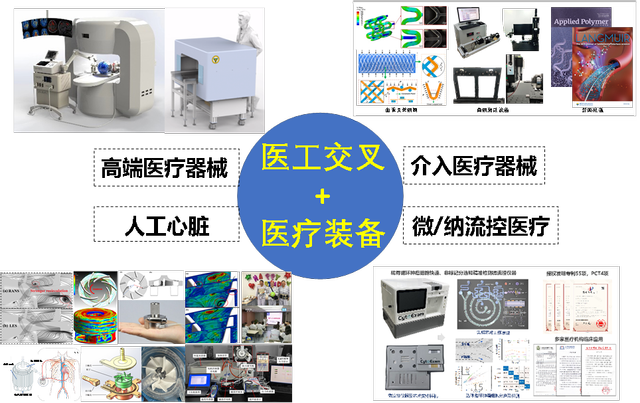
The Department of Medical Equipment, School of Mechanical Engineering, houses the Jiangsu Provincial Key Laboratory of Precision Medical Equipment Design and Manufacturing. It currently has 5 professors, 5 associate professors, and 4 postdoctoral fellows, including 1 recipient of the State Council Special Allowance, 1 second-level professor, 1 National High-level Young Professional, 2 Jiangsu Provincial Outstanding Youth Fund recipients, and 1 Young Talent supported by the Provincial Association for Science and Technology. The department supervises over 100 doctoral and master's students. Main research directions include: high-end medical devices, artificial hearts, interventional medical devices, and micro/nanofluidic medical technology.
The team from the Department of Medical Equipment, leveraging the Jiangsu Provincial Key Laboratory of Precision Medical Equipment Design and Manufacturing, has long been engaged in the integration and application of advanced manufacturing theories and related enabling technologies, as well as research on fundamental generic scientific problems and key technologies for the design and manufacturing of micro/nano medical devices. They have received numerous awards, including 1 second prize of the National Natural Science Award, 1 first prize of the Ministry of Education Natural Science Award, 2 first prizes and 2 second prizes of the Jiangsu Provincial Science and Technology Progress Award. Team members have been selected for prestigious talent programs such as the Ministry of Education's "Program for New Century Excellent Talents", Jiangsu Province's "333" High-level Scientific and Technological Talent (Second Level), Jiangsu Province's "Six Talent Peaks" Program (Level A), and Jiangsu Province's "Qinglan Project" Young and Middle-aged Academic Leaders. The team has led or undertaken over 30 research projects, including National 973 Program projects, National Natural Science Foundation Major Research Instrument Development Projects, foundational key projects of the State Administration of Science, Technology and Industry for National Defence, National Natural Science Foundation Major Research Plan Cultivation Projects, National Natural Science Foundation General Projects, National 863 Program projects, and Jiangsu Provincial Major Scientific and Technological Achievement Transformation Projects.
Key achievements developed by the department include: a third-generation gene sequencing system based on solid-state nanopores; a label-free, precise microfluidic chip for detecting "rare circulating tumor cells"; nanoscale channel fabrication technology based on dielectric breakdown; additive manufacturing processes for microfluidic chips; development of biodegradable stents; a non-invasive micro-nuclear magnetic resonance detector for diabetes; a high-end visualization precision diagnosis and treatment system; a high-performance artificial heart; and flexible wearable sensors.
To date, the Department of Medical Equipment has produced over 10 doctoral graduates and more than 40 master's graduates. The department focuses on the research and development of medical equipment and devices such as imaging equipment, diagnostic and therapeutic devices, monitoring equipment, testing instruments, and detection sensors, involving technologies like mechanics, electronics, materials science, and software. Approximately 30% of graduates pursue further studies (master's, doctoral, or postdoctoral research) at institutions such as the University of Sydney, the University of Hong Kong, and Zhejiang University. About 70% of graduates enter key positions in companies and institutions such as Mindray, United Imaging, MicroPort, Huawei, Philips, and China Electronics Technology Group Corporation.